
Those interested are welcome to consult the Wikipedia article on the very first Academy Awards. What follow below are my thoughts on the Best Picture, Best Directing, Best Actor and Best Actress winners.
The Oscar ceremony recognizing movies released between August 1, 1927 to July 31, 1928 was held in 1929, which is when the picture above was taken.

1. Outstanding Picture: Wings
Two aspiring pilots find themselves at odds over a beautiful socialite as America enters World War I. In 2023 this silent film resembles nothing so much as a series of cut scenes from a video game, and I was surprised how easy it was to watch.
The aerial combat scenes (and, to a lesser extent, this tracking shot) blew people's minds in 1927, and Wings was also one of the first big movies to show both male and female nudity. Clara Bow, who appears as one of the two love interests, was a huge sex symbol in the late 20s, and her likeness features on many of the posters for Wings.
Fun Fact: Margot Robbie's character in 2022's Babylon is based on Clara Bow. Many of the rumors regarding Bow's sexual proclivities were, however, untrue.

2. Best Unique and Artistic Picture: Sunrise: A Song of Two Humans
German director F.W. Murnau's first American feature, and a film often referred to as "the greatest silent movie ever made." It's more technically accomplished than the other movies discussed here, but I'm not sure that it holds up as well in terms of story.
After Sunrise Murnau would go on to make three more films, 4 Devils, City Girl and Tabu: A Story of the South Seas. 4 Devils was lost after its release in theaters, and Tabu was released after the director's death in 1931.
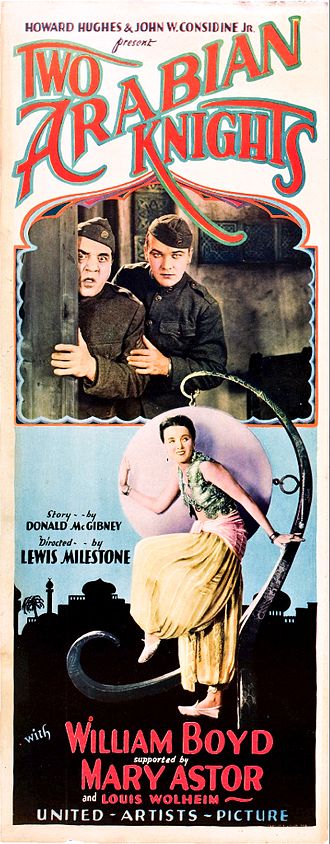
3. Best Directing (Comedy): Lewis Milestone (Two Arabian Knights)
Brought to you by Howard Hughes!
In Two Arabian Knights a pair of American POWs try to evade the Germans while contesting for the love of a beautiful Arab princess. I can only assume that audiences in 1927 found this movie hilarious, because it sure wasn't doing anything for me.
Star William Boyd would go on to portray Hopalong Cassidy for many years after. Director Lewis Milestone had a long career ahead of him, helming such films as All Quiet on the Western Front, The Front Page and Of Mice and Men.
.jpg)
4. Best Directing (Drama): Frank Borzage (7th Heaven)
A Parisian street cleaner takes in a woman down on her luck. 7th Heaven lost in the "Outstanding Picture" category to Wings, but Frank Borzage won Best Director (Drama) for his skillful handling of this story of love found in an unlikely place.
A remake of this movie set in the modern day could work very well. The desperation, the search for love and the idea of divine intervention in human affairs are all just as relevant today as they were in 1927.

5. Best Actor: Emil Jannings (The Last Command and The Way of All Flesh)
Of the movies discussed here The Last Command is my favorite by far. It tells a timely story of a great man's rise and fall, the way in which it tells this story is both precise and sweeping in scope, and Emil Jannings is undeniably great in the lead role. I'm neither here nor there with Janet Gaynor winning the first-ever Best Actress award, but yeah, Jannings amply deserved his Best Actor Oscar.
Unlike the other movies discussed here, all of which saw release in 1927, The Last Command was released in 1928,
Sad Fact: Jannings would go on to star in several Nazi propaganda films leading up to WWII. His doing so effectively ended his career in movies.
.jpg)
6. Best Actress: Janet Gaynor (7th Heaven, Street Angel and Sunrise)
I haven't seen Street Angel and I probably never will, but Gaynor's haunting eyes and doll-like face add a lot to the two movies in her filmography that I've seen. Of these two movies I definitely prefer 7th Heaven, as she passes through a much wider range of emotions in that film.
.jpg)
7. Honorable Mention: Metropolis
One of the earliest science fiction movies and, I would argue, the most culturally relevant film of 1927. Director Fritz Lang made Metropolis while still resident in Germany, and it showcases both his German expressionism and his awe of America, the country he would later call home.
In terms of depth I'm not sure if the biblical themes are as profound as some make them out to be, but Metropolis remains a classic.
Parting Thoughts
Taking only the movies discussed here into consideration, the Germans seemed to have had an effect on cinema far disproportionate to the number Germans actively involved in making films at the time. F.W. Murnau, Fritz Lang and Emil Jannings are all evidence of this trend. The German influence would wane after World War II, but it's surprising how strong a presence they were up until that point.
All in all I enjoyed the films above, even if my mind wandered at times. It's funny, but I can almost remember some of them as if the characters in them were audible. In the absence of sufficient sensory input, I suppose our minds always want to fill in the blanks, and this "weakness" of the human brain works, I further suppose, to either our advantage and disadvantage depending on the situation.
Looking to give silent films a try? These movies would be a good place to start. I can't see myself venturing still further backward into the history of film anytime soon, but this era in movie-making is definitely less foreign to me now.
Related Entries:

