顯示具有 alan moore 標籤的文章。 顯示所有文章

2021年10月1日 星期五

Where Are They Now?


When I was in elementary and junior high school I was obsessed with comic books.  I lived and breathed the Justice League, the Avengers, the Hulk and the Flash.  When I wasn't reading new comic books I was rereading old ones, and when I wasn't rereading old comic books I was thinking up ways to scam my parents out of their pocket change.  Back then you really could buy comic books for pocket change.  In 2021 it's a different story.  

As I grew older my love for comic books diminished.  Puberty and the worries of adulthood took center stage.  I still read comic books from time to time, but with nowhere near the frequency or fervency I once did.  Comic books were once my life; now they're just a small part of it.

A lot of my heroes growing up were the guys (and they were almost always guys) who wrote or drew my favorite comic books.  These were creators more prominent in the mid to late 80s, though I also admired a few of the "newer" guys who popped up in the early 90s.  For a long time I thought that being a comic book artist was the best job anyone could have, and after high school I even considered art school as a way of preparing for that career.

Alas, it was not to be.  Not that I despair overmuch.  A lot of good things have happened in my life, and I'm happy with the way things have turned out.  And of course there's also the fact that being a comic book artist isn't without its own set of challenges, many of which are corporate in nature and not fun to think about.  Point to any famous comic book creator and you'll find a series of compromises.

With all of this in mind, I got to wondering what the heroes of my childhood are up to these days.  I did a little online snooping, and what you see below is what I discovered.


1. Frank Miller

Why I Worshiped Him: His run on Daredevil most of all, but also later projects like The Dark Knight Returns, Batman: Year One, Ronin, Elektra: Assassin and to a lesser extent Sin City.  Say what you will about his more recent output or public persona, he was a big deal in the 80s.

What He's Up to Now: He's a co-creator and co-producer of the Netflix series Cursed, which is based on one of his comics.  He's also being sued for "defamation and economic interference" by someone he worked with on Sin City: A Dame to Kill For.  While sometimes accused of having right wing (or even fascist) beliefs, he describes himself as a Libertarian.


2. Alan Moore

Why I Worshiped Him: Swamp Thing.  Mostly Swamp Thing.  I liked Watchmen, and at the time I recognized that it was something truly original, but it didn't grab me the way it grabbed other people.  There were also the endless delays between issues.  Those delays dampened a lot of people's enthusiasm.

What He's Up to Now: He's been up to a lot of random stuff.  He "retired from regularly writing comics" in 2016 after writing the last League of Extraordinary Gentlemen book.  His other projects have included an app for making digital comics, a book on magic and a few essays.  He considers himself a magician, and espouses various counter-cultural beliefs.


3. Carmine Infantino

Why I Worshiped Him: His pencils on The Flash.  For the longest time nobody could draw objects in motion like that guy.  He had such a distinctive style, and it really added a lot to the character he was drawing.

What He's Up to Now: He is, sadly, no longer with us.  He died in 2013.  In the early 2000s he sued DC Comics over several Flash-related characters he'd created, but the lawsuit was dismissed.


4. Todd McFarlane

Why I Worshiped Him: By the time Spawn happened I was already a little tired of McFarlane, but his earlier stuff at DC and Marvel was great.  He pretty much reinvented Spider-Man - at least in a visual sense - and I was also a big fan of how he drew the Hulk.

What He's Up to Now: He's still trying to make that Spawn reboot happen.  As of August 2021 studio hand Brian Tucker was rewriting McFarlane's screenplay, with Jamie Foxx (supposedly) still attached to star as Spawn.  King Spawn recently proved that Spawn can still be a hit at comic book shops.


5. John Byrne

Why I Worshiped Him: If you grew up in the 80s Byrne was pretty much The Guy, and his art was all over several prominent Marvel and DC projects.  My favorite of his many projects was definitely his run on Fantastic Four, which I think best suited his drawing style and his way of telling a story.  His time on X-men alongside writer Chris Claremont is of course iconic, but the Fantastic Four is what really did it for me.

What He's Up to Now: Not much, as far as I can tell.  He's good at shooting his mouth off in the press, and I've watched a couple of recent interviews with him on YouTube, but he hasn't worked on any comic books since 2013.


6. Walt Simonson

Why I Worshiped Him: His work on Thor was amazing.  I can remember him doing other stuff: X-Factor, Manhunter, a few other things, but Thor was like this wonderful, special thing that only a few of us knew about.  He struck the perfect balance between fantasy and science fiction in that book, and it remains influential years later.

What He's Up to Now: In 2014 he published the creator-owned Ragnarok, which is a retelling of the Norse myth outside of Marvel canon.  He has a page on Facebook and still does interviews on occasion.


7. Jim Lee

Why I Worshiped Him: I didn't actually.  I always thought his art was kind of soulless.  BUT he was a big deal in the late 80s/early 90s, and the guy knew how to draw hot women.  He definitely has a strong work ethic, but I guess I like my artists a little less... polished?

What He's Up to Now: He's the SOLE PUBLISHER of DC Comics.  He's also been the Chief Creative Officer of DC Comics.  The "Image guy" is now, indisputably, the comic book Establishment.  Funny how things turn out.

Dude also has NINE children, whose ages span two decades.
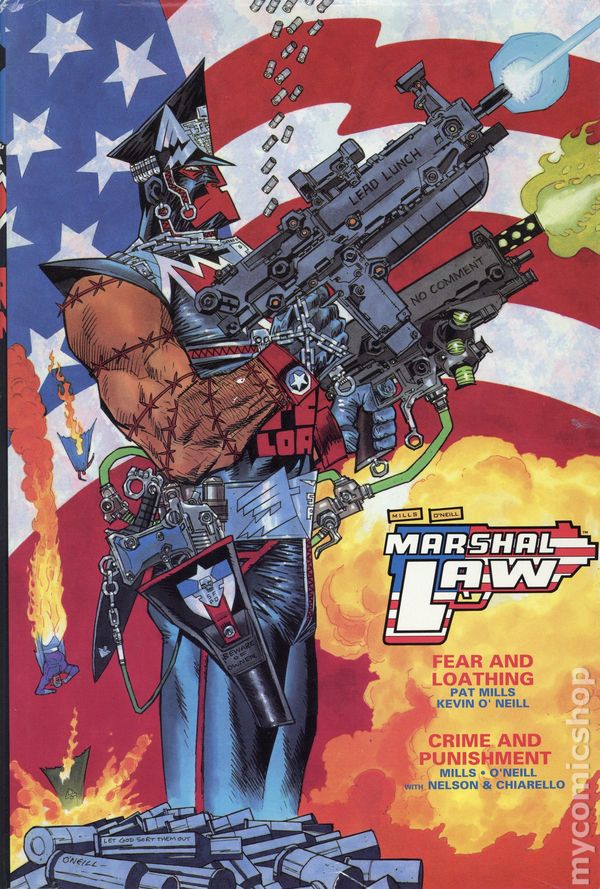

8. Pat Mills and Kevin O'Neill

Why I Worshiped Them: At some point in the 80s I started reading British comics.  Judge Dredd, Strontium Dog and (more than anything) Nemesis the Warlock.  Nemesis was a very distinctive comic for the time, and my admiration for Mills and O'Neill only increased with the release of Marshal Law under Marvel's Epic Comics imprint.

What They're Up to Now: In 2017 Mills co-wrote a novel with O'Neill, and in 2018 the movie Accident Man was adapted from one of Mills' comics.  O'Neill, whose entire art style was found objectionable by the Comics Code Authority, continues to work alongside Alan Moore on several projects.


9. George Perez

Why I Worshiped Him: Crisis on Infinite Earths blew people's minds back in the day.  Those sprawling gatefold covers, the cosmic mindfuckery, the extreme pathos - a lot of that was down to George Perez and his distinctive way of drawing.  Sure, Marv Wolfman was in there somewhere, but Perez was the one who nailed it.  Compare Crisis to Marvel crossover spectaculars of the time, and in Crisis you'll find a lot more consistency from one panel to the next.  George Perez never, ever phoned it in... at least back then.

What He's Up to Now: Despite his early work at DC, he gained a reputation for inconsistency.  He bounced around between several comic book publishers until 2019, when he formally announced his retirement.
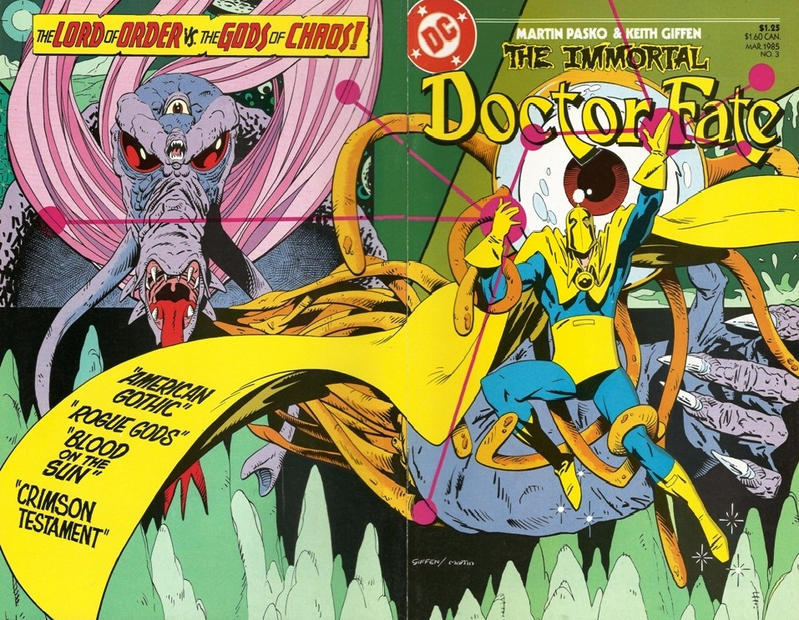

10. Keith Giffen

Why I Worshiped Him: That weirdass Doctor Fate series.  Giffen might have been the weirdest penciller working in the 80s, and Doctor Fate suited him to a tee.  Terrifying finger mouths.  Horrible looking monsters.  In the presence of Dr. Fate's ridiculous costume he made it all work.  His run (as writer) on Justice League International was also really funny.

What He's Up to Now: His work on Doctor Fate might have been too similar to work done by an Argentinian artist, Jose Antonio Munoz.  Critics claimed that Giffen had been copying from Munoz's work, while Giffen claimed that he was only unconsciously reproduced the Munoz's art style.  He's still working in comics, primarily as a writer.

Related Entries:

2014年1月14日 星期二

"The Dark Knight Returns" and "Watchmen"

The Batman of The Dark Knight Returns ends an age-old argument.

If you can remember 1986, and if you can remember buying comics at that time, then you no doubt have fond memories of that particular year.

1986 was the year that both "The Dark Knight Returns" and "Watchmen" appeared in comic book shops, and it was the year that Alan Moore, Frank Miller, and Dave Gibbons effectively reinvented the genre.


Watchmen: the old Charlton characters writ large.

Up until the appearance of those two landmark comic books, the worlds inhabited by Superman, Spider-man, and co. were fairly predictable places, where muscled champions fought monthly battles against costumed foes.  After the appearance of those two comics, everything was different, everything was possible, and everything was new.

In 1986 I was 11 going on 12, and this was the perfect age in which to experience the transformation of the comic book industry.  Up until The Dark Knight Returns and Watchmen, I was an avid follower of The Flash, Daredevil, and the Justice League.  Up until those two tiles appeared I was also, like most boys my age, a master of comic book trivia.  I knew what artist pencilled Daredevil after Frank Miller left the book.  I knew who wrote the good Flash comics.  I even knew the names of a few inkers.


Things get heavy in Watchmen.

And then, almost all at once, that world came to an end.

There were hints of it in DC's "Crisis on Infinite Earths."  There were rumblings in the direction of Swamp Thing.  There were glimpses in the new line of graphic novels.  Comics, all of the sudden, got more complex, and much more adult.

I freaking LOVED The Dark Knight Returns.  But then I had already been a longtime fan of Frank Miller.  I loved his idea of an older Batman.  I loved his art.  I loved his characters' internal monologues.  I couldn't believe how cool that comic series was, and how lame my former favorites seemed after I had read it.


"Marshal Law."  Great, but sadly overlooked by most.

Watchmen took longer to grow on me.  It may have been because it was less "superheroic" than Frank Miller's creation.  It may have been too deconstructionist for my liking.  It might have simply been over my head.  But my friends and I could all agree that the covers looked cool, and that the plot had a way of grabbing your attention.  By the third issue of the series I was intrigued.  By the sixth issue I was a fan.  By the 12th issue I was wondering how any comic book team could top that series in terms of drama and intricacy.

I am still wondering.


"Elektra Assassin."  Quite possibly my favorite comic book ever.

Watchmen, by the time it finally concluded (there were a lot of delays), had rocked my world to its very foundations.  While I walked away from The Dark Knight Returns thinking that Frank Miller was The Man, Watchmen left me pondering the possibilities of the comic book as an art form.  They were two very different comic books, that made two very different impressions.

Both of these comics were also great because they opened the door to a host of other, more adult creations.  I have fond memories of Mills and O'Neill's "Marshal Law," Rick Veitch's "The One,"and other, similarly strange comics.  The only exception was Neil Gaiman's work on Sandman, which never appealed to me.  To this day, I fail to understand why he's so famous.


Todd McFarlane's Spider-Man #1, with all its variant covers...

But of course the comic book renaissance started by Watchman and The Dark Knight Returns was all too brief.  As the 90s drew closer and closer, a more market-driven sort of comic book began to appear, and both creators and companies increasingly sought to cash-in on their creations.  Suddenly every #1 came in three, four, or twenty different covers.  Suddenly every other comic book came in its own sealed bag, so that you had to buy two - one to read, and one as an investment.  Suddenly trading cards were included in each comic, or holographic covers, or special silver ink.  It all got very ridiculous, and in their rush to cash-in, many companies failed to realize that it was the content of the comics that mattered, not the gimmicks attached to them.


X-Men #1 with its gatefold cover.  This was really the beginning of the end...

Those more market-driven comic books almost killed the industry, and a few years later even Marvel and DC were in serious financial trouble.  This financial trouble is one of the reasons that multiple film studios now hold the rights to Marvel characters, and why a lot of the guys (and girls) who wrote or drew comics in the late 80s no longer continue to do so.

But for a while there, between The Dark Knight Returns, Watchmen, and the gatefold holographic trading card covers, it seemed like anything was possible.  It seemed that what waited in the wings was probably better and more thoroughly imagined than anything we had seen before.  Frank Miller, Alan Moore, and Dave Gibbons gave us that feeling, and each month we waited, with baited breath, for the next issue to hit the stands.

Classic beat down.

2013年8月4日 星期日

"The League of Extraordinary Gentlemen: Volume One" by Alan Moore and Kevin O'Neill


Didn't like this one as much as I thought I would.  In case you haven't seen the movie, a group of literary characters team up to battle evil.  It sounds like a great premise, but then again Philip Jose Farmer explored a similar theme in his Riverworld series - long before this comic book ever appeared.

I remain a fan of Watchmen, but I can't help but feel that Alan Moore wasn't trying hard enough with this one.  Beyond the central premise and a handful of gags, there's really not much in this comic book besides trivia.  

Kevin O'Neill's art is always great when he's drawing grotesque, futuristic machines and acts of violence, but his drawing method adds little to the talkier parts of this comic.  Unfortunately for him, this comic has a lot of talky parts.

This comic book IS much better than the movie - not that that's saying much.  Taken on its own merits, I would have to say that the creative team behind this one has done much better elsewhere.

2012年8月27日 星期一

Books I Read During Summer Vacation

Between Taiwan, Thailand, and Cambodia I didn't get all that much reading done this summer.  But that's not necessarily a bad thing...

 
1. "A Game of Thrones" by George R. R. Martin

Attempts at eloquence aside, this book is simply BAD ASS.  I haven't read a fantasy novel this good since the Lord of the Rings trilogy, and Martin's books might even surpass those celebrated novels.  Where his prose lacks poetry, he more than makes up for it with believable characters, intricate plotting, and an attention to detail that is second to none.  I am very happy that I read this book, and I plan on reading the remainder of Martin's "Song of Ice and Fire" as soon as they arrive in the mail.

2. "Alan Moore's Complete WildC.A.T.S." by Alan Moore, Jim Lee, and Some Other Guys

This TPB doesn't really feel like Alan Moore until the very end.  There are enough characters - and enough backstory - to make for a truly confusing reading experience, and it doesn't get good until the last few chapters.  Jim Lee drew most of it, but his art adds little to the story.


3. "The Ultimates 2 Vol. 2: Grand Theft America" by Mark Millar and Bryan Hitch

Continuing where the first Ultimates left off, this installment finds Thor institutionalized and America at the mercy of super-powered terrorists.  Captain America gets his ass kicked, Hawkeye is way cooler than in the original Avengers comics, and the Hulk returns from exile.  Not as good as the first Ultimates, but that one is hard to top.  Great writing and art throughout.

4. "Ultimate X-Men 1" (TPB) by Mark Millar and Other Dudes

I've never been a huge X-men fan, but this one makes everyone's favorite mutants seem slightly cooler.  Confronted by the sentinels on one hand and the Weapon X program on the other, the X-men strive to overcome individual differences and work as a team.  I like Millar's version of Wolverine and Magneto, but this one was a far cry from his work on The Ultimates.

5. "A Clash of Kings" by George R. R. Martin

The sequel to "A Game of Thrones," this one follows the exploits of the Starks as they face off against the Lannisters in the wake of Eddard Stark's death.  A great, absorbing work of fantasy.

6. "A Storm of Swords" by George R. R. Martin

The third book in Martin's "Song of Ice and Fire."  Forces realign after the decisive battle for Storm's End, with enough sex, violence, and political intrigue to keep anyone interested.  Metal bands take notice: you would be well-advised to mine this book for both song titles and lyrical content.