顯示具有 science 標籤的文章。 顯示所有文章

2022年7月20日 星期三

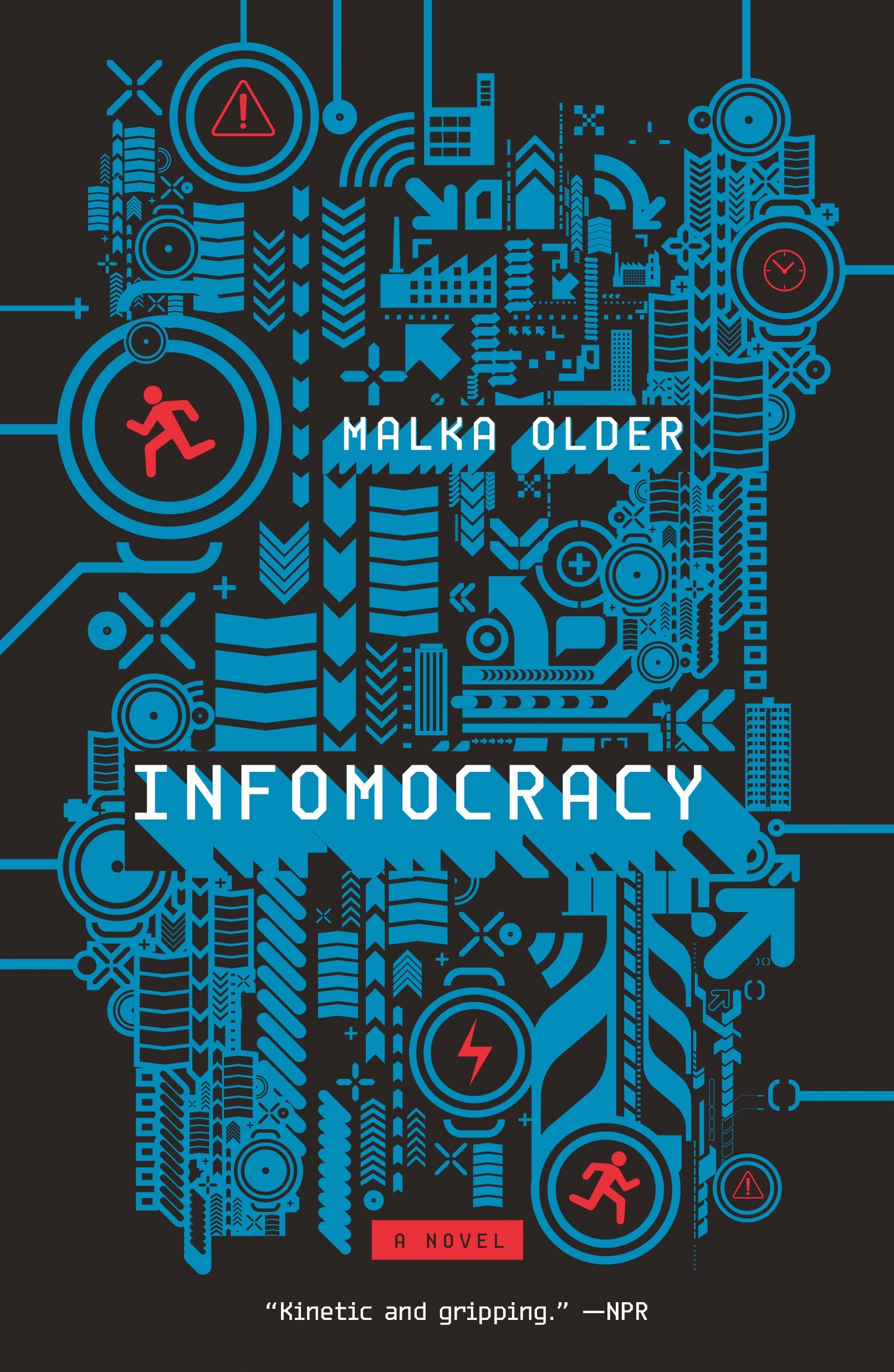
"Infomocracy" by Malka Older (2016)


"Ken runs through his destinations in his mind.  'Hard to sell in Java, though they might scrape a centenal or two together on that basis.  But Liberty's pretty weak there; PhilipMorris is the big corporate to worry about.  Singapore and Taiwan -- yeah, an anti-Japan message could still resonate.  But war?'"
 
Malka Older is a faculty member at Arizona State University and has worked for various humanitarian causes.  Her Wikipedia page reads a bit like her resume, and I'm a little suspicious of it.  Infomocracy, the novel reviewed here, is part of her "Centenal Cycle," a trilogy exploring the politics of the future.
 
Infomocracy is set in the near future, decades after global warming has caused the seas to rise and the nation-states of the present day to fall from favor.  In the wake of such upheavals the world's population has been redistributed across the surface of the globe, and this population has been divided into territorial units called "centenals."  Each centenal is administered by an elected government, and each elected government represents a political party which spans the planet, and which seeks to achieve a supermajority over other parties by winning enough centenals to influence policy on a global scale.
 
Which is where our heroes enter into the picture.  There's Ken, who campaigns for Policy1st, one of the political parties, Mishima, an agent working for Information, the future equivalent of Google, and Domaine, an ill-defined figure who's trying to bring an end to the political system altogether.  On the eve of the 10-year global elections evidence of tampering with the voting system emerges, a conspiracy seems evident, and Ken, Mishima and Domaine must contend with the machinations of more powerful groups and individuals.
 
Sounds not bad, right?  Just be aware that my description of the books' premise is clearer than anything in the book itself.  It took me 380 pages to arrive at that description, and beyond that I have retained little from this novel.  What happened before, during and after the events described above?  People mostly float around in aircraft known as "crows," stay at hotels, compile information and piece things together in the most arbitrary fashion. 
 
Oh, and there are the hilarious ninja battles involving a mix of flamethrowers and antique weaponry, apparently necessitated by the obsolescence of firearms.  People fight with swords and throwing stars inside office buildings -- they even go "Hiiiya!" when it suits them.  These parts of the book read like something Frank Miller would have dreamed up in the 80s, with the exception that Frank Miller would have framed the ninja battles within a much cooler, much better thought out story.
 
Overall this book reminded me of William Gibson, but again, William Gibson would have placed what passes for a plot in Infomocracy into a larger context, supplying much-needed reasons for what's happening and why.  As it is, Infomocracy has all the zest of millennials working at Google or campaigning for Joe Biden.  It's the story of disconnected people who just aren't that interesting, struggling to preserve a system that seems as open to abuse as the order of things it replaced.  What happened in this book, really?  To whom?  And why should anyone care?  In the end you can only shake your head at it, and wonder at the author's ability to pile word upon word with so little effect.
 
Related Entries:
 

2014年9月27日 星期六

"Time Reborn" by Lee Smolin (2013)


"Logic is not the mirror of causality."

Lee Smolin is a theoretical physicist resident at the University of Toronto.  As a theoretician, he is known for his work in loop quantum gravity, cosmological natural selection, and the philosophy of physics.  As an author, he is known for the books "The Life of the Cosmos," "Three Roads to Quantum Gravity," "The Trouble with Physics," and this book, "Time Reborn."

"Time Reborn" discusses the role of time in physical models of the universe, and how current cosmological theory needs to be reformulated to accommodate the reality of time.  In other words, the picture of the universe achieved through Newtonian, Einsteinian, or quantum physics is static (timeless), and needs to be adjusted (or transformed entirely) to reflect the role of temporality - or causality - in our observations of natural phenomena.

And if some of what I said above got by you, don't worry.  It took me a while, too.  I had to read the first few chapters of this book SLOWLY, and there were a few sections I had to reread just to make sure I understood them correctly.  "Time Reborn" might be a short book, but it is a dense book, and some of the earlier chapters require concentration.  The part about "space atoms" gave me particular trouble, and even now I'm not entirely sure I understand it.

Which isn't to say that I found "Time Reborn" boring or difficult.  On the contrary, it's one of the most interesting books I've read in a while.  It offers a lot more than the generic "Wow!  Quantum physics!" that many popular science books are offering, and instead challenges the reader to think through a series of propositions.  Granted, some of these propositions must be taken on faith, but the author makes a very convincing case just the same.

If you like reading about philosophy, science, and the nature of reality I would highly recommend this book.  It challenges accepted notions in a way that any good book ought to.

2014年3月26日 星期三

"The Best American Science Writing: 2012," edited by Michio Kaku


"To those who find the Many Worlds Interpretation needlessly baroque, Deutsch writes, 'the quantum theory of parallel universes is not the problem - it is the solution... It is the explanation - the only one that is tenable - of a remarkable and counterintuitive reality.'  The theory also explains how quantum computers might work.  Deutsch told me that a quantum computer would be 'the first technology that allows useful tasks to be performed in collaboration between parallel universes.'  The quantum computer's processing power would come from a kind of outsourcing of work, in which calculations literally take place in other universes.  Entangled particles would function as paths of communication among different universes, sharing information and gathering the results.  So, for example, with the case of Shor's algorithm, Deutsch said, 'When we run such an algorithm, countless instances of us are also running it in other universes (by creating a superposition) and as a result they perform part of the computation on a huge variety of different inputs.  Later, those values affect each other, and thereby all contribute to the final answer, in just such a way that the same answer appears in all the universes.'"

Great, you say in your particular universe, but why is he reviewing the 2012 edition of "The Best American Science Writing"?  Why not the 2013 edition?  The answer, my universal friend, is that the 2013 edition was not available in this universe.  In an adjacent universe, they had the 2013 edition, and I reviewed that one.  Perhaps one day I can view that review on my own quantum computer, and thereby discover whether or not the 2013 edition was superior to the 2012 edition.  Yes, that makes sense.  I think.

This book covers a wide range of science topics, but my favorite articles, save one, fell within the domain of physics.  The two "psychological" articles ("Beautiful Brains" and "Criminal Minds") are pure crap, but the rest of this book is fairly interesting.  As you might have guessed from the above quote, my favorite article was the one about quantum computers.  The article at the very end of the book, "God Knows Where I Am," dealing with mental illness and public policy, is also very good.

I'll be reviewing the 2013 version when I come across it.  Unless another version of myself, writing in another universe, posts it here first!

2013年11月22日 星期五

Best of Summer/Fall 2013

I've been reading A LOT of books.

But after "Collapse," the last book reviewed here, I am now without any books to read.  This will probably be the case until at least Chinese New Year, when I'm sure I'll be in Taipei, Kaohsiung, or some other place where I can buy books.  Until then, consider this the end of my book reviews.

You can click on the titles for a longer review of each book.


10 Best Books

1. "Childhood's End" by Arthur C. Clarke

This is the book that made Clarke famous, and this is also a book that proves his fame is well-deserved.  Not only is it well thought out and meticulously plotted, but the prose is far superior to what you find in most science fiction novels.  Truly a great work by a great writer.

2. "A Century of Science Fiction 1950-1959" edited by Robert Silverberg

There are a few stories in this one that are probably best forgotten, but for each forgettable story there are two excellent works of short fiction.  My favorites in this one were the stories by Philip Jose Farmer and Jack Vance.

3. "The Gates of Creation" by Philip Jose Farmer

Kind of like Conan the Barbarian meets Dune.  This is the second book in Farmer's "World of Tiers" series, and I would love to read the other two books.  Farmer might have written a lot of crap, but this novel is excellent.

4. "Soul Catcher" by Frank Herbert

Perhaps the only "serious" (non-genre) fiction penned by Herbert.  This one takes place in the Pacific Northwest, where an Indian guide kidnaps a young boy.  The ending is a bit disappointing, but this book gets deep.

5. "A Canticle for Leibowitz" by Walter M. Miller Jr.

Possibly one of the most profound science fiction novels ever written.   Miller Jr.'s novel of post-apocalyptic survival does not make for easy reading, but it is the kind of book that makes an impression.

6. "Venus Plus X" by Theodore Sturgeon

This book is trippy, and I like that.  One of Theodore Sturgeon's two most famous books, this one explores the battle of the sexes from the perspective of an alien race.  Even if you don't agree with the author's historical premise, it's still a great story.

7. "All the Pretty Horses" by Cormac McCarthy

The first book in McCarthy's "Border Trilogy."  This one follows two friends as they explore Mexico on horseback.  The part in the Mexican prison is one of the most harrowing things I've ever read.

8. "Jazz" by Toni Morrison

Even if some of this book does invite unflattering comparisons to Faulkner, Morrison's "Jazz" is very much its own novel, with its own kind of story to tell.  Definitely worth reading.

9. "Peace on Earth" by Stanislaw Lem

Lem at his most slapstick, and Lem at his most paranoid.  An astronaut visits robots on the moon, and returns with a brain severed into two halves.  Certainly one of the strangest and best science fiction novels I've ever read.

10. "Radio Free Albemuth" by Philip K. Dick

A nice companion to Dick's VALIS.  In this book, which can be considered a forerunner of that more famous book, Dick explores the relationship between a record executive, the extraterrestrial intelligence offering him "enlightenment," and a tyrant bent on (inter)national domination. 

Honorable Mention: Frank Herbert's "The Eyes of Heisenberg"


5 Books That Just Weren't Very Good

1. "Lord of Light" by Roger Zelazny

Buddha without the Buddhism.  Science fiction without the science.  Gods war against one another with gizmos, and none of it makes a great deal of sense.

2. "The Heaven Makers" by Frank Herbert

Wow this book was boring.  One of the worst books Herbert ever wrote, and certainly one of the reasons people can't take him seriously outside of "Dune."  The sexual parts were almost interesting, but they couldn't save the book.

3. "Gather, Darkness!" by Fritz Leiber

An order of monks brainwash the populace with a technology they themselves don't understand.  This one might make even less sense than "Lord of Light."

4. "The White Plague" by Frank Herbert

Wow this book is even more boring than "The Heaven Makers" - and also a lot longer.  A plague decimates the women of the world, and leaves the men searching for answers.  It tries to be deep, but fails miserably.

5. "Microworlds" by Stanislaw Lem

Lem comes across as a cranky old man in the non-fiction "Microworlds."  I am sorry that he ever wrote this book, for the simple reason that it will dissuade people from reading his novels - some of which are fantastic.  In this book Lem attempts to put science fiction under a microscope, but the order of magnification is so high that he fails to see anything of substance.

Dishonorable Mention: Marion Zimmer Bradley's "The Planet Savers/Sword of Aldones."