顯示具有 oscars 標籤的文章。 顯示所有文章

2025年11月9日 星期日

Still More 80s Movies 5: Oscar Winners

Everything said in the intro to the Still More 60s Movies 5 entry still stands.  On to the next!


1980

1. Best Foreign Language Film: The Tin Drum

I read and loved the book.  One of the best novels ever.

The movie version is very faithful to the novel, which makes sense given that Gunther Grass acted as advisor to the production.  The "sex scenes" involving then-11 year old David Bennent were very controversial at the time, and the film was banned in several countries, but The Tin Drum was critically acclaimed, and I've seen much worse in much earlier films.

Fun Fact: Star David Bennent would go on to appear in 1985's Legend alongside Tom Cruise and Mia Sara.  That one role was as far into American films as he ever ventured.

2. Best Music: A Little Romance

An American girl (Diane Lane!) living in Paris falls in love with a French boy she meets on a film set.  Director George Roy Hill also directed The Sting and Butch Cassidy and the Sundance Kid, two movies which are featured in this one.  He'd only do three more movies in the 80s: The World According to Garp, The Little Drummer Girl and the Chevy Chase vehicle Funny Farm before going on to teach drama at Yale.


1981

1. Best Foreign Language Film: Moscow Does Not Believe in Tears

A factory girl searches for love in Russia's biggest city.  I didn't like this one as much as Dersu Uzala, another Russian movie seen recently, but it was still very enjoyable.  The story is framed as a debate between modernism and traditional Russian values, and I'm not sure that the protagonist makes the right choice at the end, but then again it's not my culture, and her settling down with a man who seems both extremely proud and extremely temperamental makes a certain kind of sense.

Older Russian movies never seem to have the "hook" seen in Western movies: that crucial opening scene present to pique the viewer's interest.  It's a very different approach to storytelling.


The famous violinist visits China, where he engages in several musical exchanges with musicians there.  It seems lightweight at first, but then the school director is talking about being locked in a closet for 14 months, to the point where his legs stopped working properly.  

China has come a long, long way in 40+ years.  Hopefully the present regime recognizes that some of this progress was due to goodwill exchanges like Stern's trips to Beijing and Shanghai.


1983

1. Best Documentary: Genocide

Like some other Oscar-winners recently reviewed here, these being The Diary of Anne Frank and Black Fox, Genocide once again proves that WWII movies score big when it comes to the Academy.

Genocide, narrated by Orson Welles and Elizabeth Taylor, is a study of the Holocaust.  Like the other films listed above, it's not an easy watch, but you'll walk away from it with a renewed appreciation of how easily fascism infiltrates most democratic societies.  "Making Germany great again" indeed.

2. Best Documentary (Short Subject): Close Harmony

One choir composed of young children and another composed of senior citizens come together in song.  The end result is somewhat cacophonous, but the interviews with the children about how they perceive both age and aging are interesting.


1984

1. Best Documentary: He Makes Me Feel Like Dancin'

The founder of the National Dance Institute prepares a class of a thousand kids for a dance performance narrated by Kevin Kline.  Not sure why this one deserved an Academy Award, but it's OK.

2. Best Documentary (Short Subject): Flamenco at 5:15

I begin to realize that the kind of "flamenco dancing" seen in ballroom dance competitions is at best a pale reflection of the real thing.  The combination of music, dance and sheer timing in the performances is truly impressive.


1985

1. Best Foreign Language Film: Dangerous Moves

This movie didn't scream "Oscar" to me, but the ending is cool.  I also enjoyed seeing Liv Ullman, who some may remember from several Ingmar Bergman movies.  The story is centered around a series of chess matches between two Grandmasters for the World Championship.  I'll agree that it sounds boring, but it flows along nicely and the battle of wills between the two protagonists is interesting.

2. Best Documentary: The Times of Harvey Milk

I liked 2008's Milk, and Sean Penn deserved the Best Actor Oscar for it, but Gus Van Sant's movie doesn't do the best job of demonstrating why people cared so much about Harvey Milk.  This searching documentary provides a more thorough examination of that topic, and will leave you with a lot to think about.


1986

1. Best Actress: Geraldine Page: The Trip to Bountiful

An unhappy woman ventures back to her hometown after a overlong sojourn in the city.

And hey, isn't that Rebecca De Mornay?  Who once made me so "hornay?"  She appeared in Risky Business two years before, and after The Trip to Bountiful she'd go on to appear in both Backdraft and The Hand That Rocks the Cradle.  She's still around, by the way.  The last thing I can remember seeing her in was Netflix's Jessica Jones, which aired around 2019, but she's been in movies as recent as last year.

Geraldine Page?  I'm not that familiar with her.  Her film career stretched all the way back to 1953, and her last movie hit theaters in 1987.  She may not have won an Oscar until the end of career, but she was nominated many, many times before that.

2. Best Documentary: Broken Rainbow

Strap yourself in, because this one gets intense.  Broken Rainbow details the history of exploitation between the Hopi, the Navajo and the U.S. government, at the time of filming most directly expressed as the forced relocation of Navajo people from Hopi lands as part of a mining scheme.  The part about birth defects resulting from uranium mining is particularly hard to watch.


1987

1. Best Foreign Language Film: The Assault

A man struggles with childhood memories of World War II while unexpected acquaintances keep reappearing in his life.  I felt like the structure of the story probably worked better in the novel.

2. Best Documentary (Short Subject): Women for America, for the World

Several women urge against complacency with regard to nuclear proliferation.  I was 11 years old when this came out, but I can still remember that sense of imminent threat.  Movies like Threads and The Day After hit us hard.


1988


A series of interviews regarding an influential lunch club that took place in New York's Algonquin Hotel.  Several of those in attendance went on to fame as poets, actresses, playwrights, journalists and authors of note.  This one was a lot more interesting than I thought it would be, touching as it does upon many social issues prevalent in the 1920s.  Quite a party while it lasted.  Too bad the Great Depression was waiting in the wings.

2. Best Documentary (Short Subject): Young at Heart

A pair of octogenarian painters share their personal philosophies.  Their thoughts on aging: 1) don't spend too much time mourning or looking backward, and 2) make yourself busy.


1989

1. Best Foreign Language Film: Pelle the Conqueror

Quite depressing as foreign movies go, but beautifully filmed with enough twists and turns to keep the viewer interested.  I agree with the critics: this one's great.*


The only movie here I didn't finish.  It gets bogged down in a lot of details regarding the French Resistance, and never elevates itself above decades-old quarrels which will never be resolved.

Besides, I'm getting tired of Nazis.  The Third Reich will put you at least 1/4 of the way toward your Oscar dreams, but only so many Nazi-themed movies can be viewed in the same time period.

Related Entries:

Still More 70s Movies 4

*If you're watching this movie via the link provided be warned: the subtitles only work via PC or laptop, and the auto-generated text is hard to decipher.

2025年10月23日 星期四

Still More 70s Movies 5: Oscar Winners

Everything said in the intro to the Still More 60s Movies 5 entry still stands.  On to the next!


1970

1. Best Actor in a Supporting Role: Gig Young: They Shoot Horses, Don't They?

102 couples compete to win a Depression-era dance contest in Hollywood.  Jane Fonda leads the cast, with Gig Young as the announcer presiding over the event.  It's an excellent movie that portends bright careers for many of the cast and crew involved.

This was director Sydney Pollack's fifth feature film.  He wouldn't win the Oscar for Best Director until 1982's Tootsie, but the list of Oscar nominations in his filmography is truly impressive.  After They Shoot Horses, Don't They? he'd go on to direct Jeremiah Johnson, Three Days of the Condor, and 1985's Out of Africa, for which he won Best Director a second time.

Fun Fact: Bonnie Bedelia is in this.  It was her second movie.  19 years later she'd play Bruce Willis' wife in the original Die Hard.

2. Best Documentary (Short Subject): Czechoslovakia 1968

The history of Czechoslovakia told in a series of slides?  It ends with the Nazis.  I dunno, this one had me scratching my head.  It was produced by the United States Information Agency (USIA) for what I assume were propaganda purposes.


1971

1. Best Actress: Glenda Jackson: Women in Love

Glenda Jackson and Oliver Reed, two actors who've been praised here before, star in this Ken Russell-directed adaptation of the D.H. Lawrence novel.

Russell would go on to direct the excellent The Devils and Tommy, two signature movies from the decade.  Jackson would go on to appear in Sunday Bloody Sunday and a Touch of Class, for which she'd win a second Academy Award.  Reed would go on to appear in Russell's The Devils and Tommy, in addition to Burnt Offerings and David Cronenberg's The Brood.  Women in Love is a good look at what the 70s had to offer, even if it hit UK theaters in 1969, not 1970.

2. Best Documentary (Short Subject): Interviews with My Lai Veterans

Harrowing interviews with American soldiers who took part in the My Lai Massacre.  It's not an easy thing to watch and also not an easy subject to think about.


1972

1. Best Documentary (Short Subject): Sentinels of Silence

Mexican pyramids, narration by Orson Welles, and an orchestral score.  And none of it, I'm sad to say, so much as touches upon the subject of aliens.

In Search Of... it's definitely not, but it did make me want to travel.

2. Best Short Subject (Animated): The Crunch Bird

A woman buys a bird that chomps things on command.  It's worth watching for the punchline.


1973

1. Best Documentary: Marjoe

Respect to Marjoe Gortner: not only did he parlay this documentary into a movie career, but he also went on to do a love scene with a topless Lynda "Wonder Woman" Carter.

Marjoe details the 70s B-movie star's years as a preacher working the Pentecostal circuit.  He's very frank about his preaching career throughout this documentary, and I imagine this same frankness offended a lot of people at the time.


Introduction to an artist who's had more to do with how America sees itself than perhaps anyone else.  This documentary blends interviews, news footage, reenactments and samples of Rockwell's art together very well.


1974

1. Best Documentary: The Great American Cowboy

A peek inside the EXTREMELY MANLY world of rodeo.  Broken collarbone?  Walk it off!  Fractured cranium?  Get right back on that bronco!  Paralyzed from the waist down?  Go home and have a good cry, pussy!

Seriously though, this is one of the best documentaries I've seen in a while.  The London Philharmonic score adds another dimension to the movie, and the rivalry between the two rodeo champions is riveting to watch.

2. Best Documentary (Short Subject): Princeton: A Search for Answers

The "answers" being answers to the "eternal questions" asked by whatever person is teaching your "Intro to _____" course at the start of the semester.  This was a recruitment film for the prestigious university, and I'm sure it worked very well at the time.  It's also an interesting time capsule from the decade.


1975

1. Best Documentary: Hearts and Minds

Vietnam again.  It was on a lot of people's minds in the 70s.

Hearts and Minds is a rough but rewarding two hours.  Like The Great American Cowboy above it's a thoughtfully produced documentary, and it amply deserved the Oscar awarded to it.  William Westmoreland, by the way, can go fuck himself.

2. Best Short Film (Live Action): One-Eyed Men are Kings

A man living in Paris (?) makes friends and takes his dog for walks.  I don't know how they managed to make 15 minutes seem like an hour, but somehow they achieved it.


1976

1. Best Foreign Language Film: Dersu Uzala

Haven't seen a Russian movie mentioned here in a while, have we?  Maybe after Vietnam it was high time to view the U.S.S.R. and it's media with a more open mind?

In the context of the 70s you may be thinking "Tarkovsky," a director I haven't always resonated with, but if you're doubtful don't worry, Dersu Uzala is nothing like that.

In the film a Russian survey team heads into the wild, guided by one of the "Gold People," a man who's lived in the mountains his entire life.  The friendship which develops between the captain of the survey team and his guide is very touching, and the scenes of wilderness survival feel very authentic.

2. Best Documentary: The Man Who Skied Down Everest

Skiing down Everest, what could go wrong?

An icefall, apparently.  An icefall goes wrong.  Our champion Japanese skier's base camp is buried under several tons of ice, and six of his trusty Sherpas lose their lives.

Was it worth it?  I dunno, you'd have to ask him.  He's still alive, by the way, at the age of 103.


1977

1. Best Documentary: Harlan County, USA

Coal miners go on strike in a county where the odds are stacked against them.  It's a by turns fascinating, by turns depressing look at a lot of problems that were never really solved.

2. Best Costume Design: Fellini's Casanova

Even for Fellini this one's very weird, and comes complete with the lavish costumes, improbable sets and bizarre scenes you'd expect from a late 70s Italian art movie.  Donald Sutherland was an odd choice for the lead, but he's convincing throughout.

Just don't ask me what's going on with the robotic sex owl, or the dream involving the sex doll, or that statue that sinks near the beginning.  I was scratching my head over a lot of one.

Fun Fact: Fellini actually cast Sutherland over the likes of Robert Redford and Jack Nicholson.  The director had a strong dislike for the historical Casanova, and wanted a more grotesque version of the character.  To this end he had Sutherland shave part of his head and wear prosthetics for the role.


1978

1. Best Short Film (Live Action): I'll Find a Way

A girl with spina bifida takes us through her weekly schedule.  I found myself wanting to give a lot of those kids a hug.

2. Best Short Film (Animated): The Sand Castle

Strange sand creatures create themselves, or create each other, and then construct a castle which is later consumed by the wind.  A good movie to watch stoned?  Or a terrible movie to watch stoned?  I'm not sure.


1979

1. Best Documentary: Scared Straight!

Several juvenile delinquents are taken to a maximum security prison where they're harassed for two hours.  I wonder about the wisdom of mixing boys and girls in this little outing.  Why not send the girls to a women's prison?

If you're interested in this one, there's also Scared Straight: 20 Years Later with host Danny Glover.  There's also a decent parody of it by SNL.

2. Best Documentary (Short Subject): The Flight of the Gossamer Condor

Some guys try to construct a pedal-powered airplane.  Aviation enthusiasts might like it, but it made me very sleepy.

Related Entries:

2025年10月4日 星期六

Still More 60s Movies 5: Oscar Winners

This will be the last "Still More 60s Movies" entry.  For this entry I'd like to delve into some of the Oscar winners from the decade.

By way of introduction I'm approaching this topic thusly: first, I'll be visiting the Wikipedia entry for every year listed below, and second, I'll be working my way down through the lists of Oscar winners until I find a) two movies I haven't seen before, and b) two movies also available on YouTube.  Yes, I could get movies through a variety of other legal and illegal methods, but these entries are intended for a more general audience, and some of the streaming services and torrents don't work as well in certain countries.

Besides, I'm lazy sometimes.  Using VPNs, torrent clients and sites which force me to click off a thousand pop-ups is exhausting.

...oh, and one more thing -- since I'm basing this on the Academy Awards, be aware that all of the movies below came out the year before they won the award.


1960

1. Best Supporting Actress: Shelley Winters: The Diary of Anne Frank

This one hits differently in 2025.  Fascism and its close cousin ethnic nationalism are forces guiding American politics now, and immigrants, those "huddled masses yearning to breathe free," now find themselves the objects of renewed suspicion.

Besides Best Supporting Actress, The Diary of Anne Frank also won two other Oscars, one for Best Art Direction - Black and White, and one for Best Cinematography - Black and White.  In 1959 movies were facing stiffer competition from TV, and a shift away from black and white was well under way.  By the time the 40th Academy Awards were held in 1968, the Academy had stopped making a distinction between color and black and white films altogether.

Shelley Winters?  I don't think she adds much to this movie.  True, she perfected "high strung verging on hysteria," but her role in this The Diary of Anne Frank is rather marginal.  In 1959 the studio system still prevailed, and it could be that someone higher up simply decided that Winters was due for an award.  I'm not saying this to diminish her as an actress, but I don't think she deserved an Oscar for this particular film.

With respect to the movie overall I'd say that it's definitely good, though you'll want to watch it in two sittings.  The inevitable scene of their discovery near the end is very gripping, and one gets a strong sense of what the family patriarch truly lost after the war ended.

2. Best Foreign Language Film: Black Orpheus

Greek myth plays itself out in the midst of Rio's Carnaval.  It's an indisputably good movie, if a little obscure/arty at times.  I can't help but wonder if the positive reception this one received isn't more due to its unabashed sexuality than whatever depth or interest the story might have possessed for Western audiences back then.  In 1959 America was a very sexually repressed place, and outside of Grindhouse films audiences weren't likely to see so many attractive people of color enmeshed in such a ribald narrative.

Those unfamiliar with it might want to read about the myth of Orpheus and Eurydice before watching Black Orpheus.

This film won several awards besides the Best Foreign Language Film bestowed by the Academy.  It met with, however, a less than enthusiastic reception in Brazil.  I can understand their discomfort with this movie.  It does in many instances resort to stereotypes.

Fun, if Exploitative Fact: The French director of Black Orpheus, Marcel Camus, married first Marpessa Dawn, the female lead in Black Orpheus, and then Lourdes de Oliveira, a member of the supporting cast.  He was married to de Oliveira up until his death in 1982.


1961

1. Best Foreign Language Film: The Virgin Spring

Some of those reading this might be familiar with Wes Craven's early, surprise hit The Last House on the Left.  That later, more specifically horror-oriented movie was an adaptation of Ingmar Bergman's The Virgin Spring.

Bergman's version is objectively better in all respects.  It's concise, it was beautifully filmed, and the performances are very convincing.  Unlike Craven's film The Virgin Spring is set in the Middle Ages, and setting the story in this time period gives Bergman's movie a fairy tale quality that, in my opinion, works much better.

2. Best Documentary: The Horse with the Flying Tail

Not sure how this Disney-produced film won Best Documentary, but maybe there was less competition in 1961.  It's completely contrived and totally devoid of nuance, but if you're looking for a completely predictable movie with a completely predictable final act (right down to the national anthem), this is the movie for you.

It's one of the more whitebread films I've seen in a while.  Oh, and if you look real hard you'll notice the actor who gets flayed a quarter of the way through The Texas Chainsaw Massacre 2.


1962

1. Best Documentary: The Sky Above, The Mud Below (a.k.a. "Sky Above and Mud Beneath")

Strange to think of half of New Guinea as being "Dutch," but yes, in 1961 the Dutch still controlled that part of the world.  At that point in time Eddie and Alex Van Halen were kids living on the island of Java, long before they'd become internationally known rock stars.

The Sky Above, The Mud Below details a French expedition to New Guinea, referred to in the film as "a blank space on the map."  If you've seen other examples of this type of documentary nothing will be that surprising here: intrepid explorers, mostly naked native peoples, extremely staged "scenes of discovery," and battles with the elements - it's all familiar territory.

I don't think we saw much that was new in the documentary genre until Werner Herzog.  Up to that point the genre very formulaic, though there may be inventive documentaries from the time period I haven't yet seen.

2. Best Documentary (Short Subject): Project Hope

Speaking of Indonesia, Project Hope documents a medical exchange between the United States and that (relatively) new nation.  The onboard milk machine seems like a strange idea, but I suppose there was some science behind it.  Hopefully in the age of Trump we can keep this kind of thing going.


1963

1. Best Foreign Language Film: Sundays and Cybele

The acting is good, it's well written and well directed, but I'm a bit reluctant to recommend this one.  It's too much like a pedophile's wet dream.

A Frenchman recently returned from the Indochina Conflict strikes up a friendship with a young girl.  There's certainly nothing wrong with that, but yeah, anyone acting like the Frenchman in this movie - a man admittedly damaged from his experiences in the war - would end up on the wrong kind of list given enough time.

2. Best Documentary: Black Fox

The life and times of Adolph Hitler.  Like most documentaries on the subject it's certainly food for thought, even if the juxtaposition of World War II footage and Goethe's Reynaud the Fox doesn't always work.


1964

1. Best Short Subject (Cartoon): The Critic

Yes, Mel Brooks has three Oscars to his name.  The Critic, linked above, won him his first.  Give it a click?  It'll only take up 3 minutes and 24 seconds of your time.


1965

1. Best Writing: Screenplay: Becket

"One can always come to a sensible little arrangement with God."

Entirely too clean for my liking.  There's no way that people of that time period, rolling around in their own filth as they were, would have been able to enjoy such spotless floors.

The plot of Becket revolves around the friendship (and rivalry) between Henry II, Norman King of England and Thomas Becket, his Saxon friend and a rising star within both royal court and Catholic church.  Peter O'Toole, playing Henry II chews a lot of scenery in the course of this movie, while Richard Burton, playing Thomas Becket, delivers an uncharacteristically restrained performance.

Fun Fact 1: In case "Gwendolin" looks familiar, 20 years later actress Sian Phillips would go on to play the "Reverend Mother" in 1984's Dune.  While filming Becket she was still married to Peter O'Toole.

Fun Fact 2: This movie, to some extent at least, inspired a young Julia Roberts to become and actress.

1. Best Documentary: World Without Sun

Where James Cameron ventures Jacques Cousteau may have already been.

In this mildly homoerotic take on ocean exploration, the intrepid Cousteau navigates the ocean depths from his shiny new sea base.  Of all the movies I've seen lately this one is probably the best to get stoned to, featuring as it does an array of colorful and bizarre fish, weird scenes of transparent containers in the water, and plenty of descents into underwater caves.


1966

1. Best Actor in a Supporting Role: Martin Balsam: A Thousand Clowns

Too much like the play it was adapted from, but the witty dialogue and an effervescent performance by James Robards keeps it interesting.  Martin Balsam plays Robards' brother.

It's not a perfect movie, but this story of whimsical, individualistic people living in a serious, conformity-ridden society is worth seeing.  For me the standout feature was the editing, which is very inventive given the time period.

2. Best Documentary: The Eleanor Roosevelt Story

Guaranteed to drive any and all avowed Republicans from your living room.  

As for the documentary, it's mostly a series of photographs introduced by various narrators.  I'm not sure why it won the Oscar, but then again 1965 was both a long time ago and a lot closer to Eleanor Roosevelt's death three years before.  I suppose that to some extent a rising tide of feminism and concern for women's rights in the late 60s made this documentary ring true for many.

Food for Thought: Eleanor Roosevelt was most likely a lesbian, but historians debate whether or not she ever acted on her feelings for other women.  What is known is that Eleanor disliked having sexual relations with her husband, and that FDR had a series of extramarital affairs.


1967

1. Best Actress, Best Supporting Actress: Elizabeth Taylor and Sandy Dennis: Who's Afraid of Virginia Woolf?

Academia (or is it "academe?"), thwarted ambition, and bitter libations which catch in one's throat.

In my opinion there's Elizabeth Taylor and Richard Burton chewing scenery in a GOOD way, as in Who's Afraid of Virginia Woolf?, there's Elizabeth Taylor and Richard Burton chewing scenery in a NEUTRAL way, as in Cleopatra, and then there's Elizabeth Taylor and Richard Burton chewing scenery in a BAD way, as in Boom!

But in another way the real star of this movie is director Mike Nichols, who managed to wrest the respective performances out of both Mrs. Taylor and Mr. Burton.  He enjoyed one of the longer careers in Hollywood, helming everything from this movie to Charlie Wilson's War in 2007.  He elevated a lot of the material he worked with, the script of this movie included.

And yes, Elizabeth Taylor is great in this movie.  She was always great, in one way or another, even when she was drunk or stoned out of her mind.

2. Best Music: John Barry: Born Free

A couple living in Kenya attempt to reintroduce their pet lion into the wild.  In terms of content it's fairly standard Disney fare (though this isn't a Disney movie), but the relationship between the two married people and their indecision with regard to the cub makes Born Free more interesting than would have otherwise been the case.

For a postscript I highly recommend The Tragic Story of the Lord of Lions: Adamson of Africa.  It puts a lot of Born Free into perspective.


1968

1. Best Documentary: The Anderson Platoon

A French journalist follows an American platoon through scenic Vietnam.  I think this won an Oscar more for its timeliness, given that up to that point the American military wasn't as forthcoming as to how the war was really going, and the toll it was taking on both sides.  It's a decent time capsule as these things go, but as a documentary there's not much in The Anderson Platoon to sink one's teeth into.

2. Best Documentary (Short Subject): The Redwoods

Only twenty minutes long and full of creepy music.  This was the Sierra Club's attempt to educate the public on the imminent threat to California's remaining redwoods, and as a piece of propaganda it worked extremely well.  

To be fair to the U.S. timber industry, they don't clearcut like that anymore.


1969

1. Best Actor: Cliff Robertson: Charly

A retooling of Flowers for Algernon, this film features Cliff Robertson as a mentally disabled man granted superior intelligence through a new medical procedure.  If you're only familiar with Robertson as Superman's dad in 1978's Superman you'll want to check this one out.  There was a lot more to him than that one role.

2. Best Documentary: Journey into Self

Condensed version of a 16-hour therapy session.  As the 60s gave way to the 70s psychotherapy would become increasingly ubiquitous in the United States, and this documentary stands as evidence of that trend.  People in the late 60s and early 70s were searching for truth, and they thought that with the right method they could find this truth.  For some this meant joining a cult, for others it meant delving into astrology, and for still others it meant therapy sessions that sometimes did more harm than good.

Purely my opinion, but I think we sometimes put things "in the basement" for good reasons.  It's not always beneficial to venture down there and start digging things up.

Related Entries:

2023年7月23日 星期日

Academy Award Winners: 1929-1930


The third Academy Awards were held not long after the second Academy Awards.  They moved the date back so that the ceremony could be held closer to the eligibility period.  During this year the "Outstanding Picture" category was changed to "Outstanding Production."

Those interested are welcome to consult the Wikipedia article on the third Academy Awards.  What follow below are my thoughts on the Best Picture, Best Directing, Best Actor, Best Actress and Best Cinematography winners.

The Oscar ceremony recognizing movies released between August 1, 1929 to July 31, 1930 was held in 1930.


1. Outstanding Production: All Quiet on the Western Front (1930)

2. Best Director: Lewis Milestone - All Quiet on the Western Front (1930)

Lewis Milestone also won Best Directing (Comedy) for 1927's Two Arabian Knights.
 
At this point I've seen all three filmed adaptations of Erich Maria Remarque's novel, these being the 1930 and 2022 versions released in theaters, and the 1979 made for TV movie.  Of these three versions the 1979 TV movie is my favorite, primarily because it strikes, in my opinion, the best balance between the humanity of its characters and the horror of war.
 
Which is not to say that Lewis Milestone's 1930 version is bad in any respect.  If it's not -- again, in my opinion -- as good as the 1979 version it's still excellent.  1930's All Quiet on the Western Front was a considerable technical achievement, and the story it tells is still just as timely.  Just compare this film to other World War I films of the time period, everything from Hell's Angels (below) to Wings.  It's head and shoulders above those other movies, and represents, moreover, a considerable improvement over the director's own Two Arabian Knights, which won him his first Academy Award a year previous.

Fun Fact 1: Many German war veterans served as extras in this film.

Fun Fact 2: The Nazis (Brownshirts) weren't fans of this movie's anti-war message.  They disrupted several screenings of it in the years leading up to World War II.


3. Best Actor: George Arliss - Disraeli (1929)

All but surrounded by Russian spies, Benjamin Disraeli attempts to grab control of the Suez Canal in the interests of the Crown.  I'm not well read on this era in British history, but I felt that the story was convincing and George Arliss is good in the lead role.


4. Best Actress: Norma Shearer - The Divorcee (1930)

Now here's a movie that goes down MUCH differently in 2023 that it did in 1930.  Is the main character's version of turnabout fair play?  Is her husband's offended jealousy unfounded?  Is a divorced woman "ruined?"  Is their marriage salvageable?  I suppose your answers to these questions in 2023 depend more on your lifestyle, religious affiliation, gender orientation and sexual orientation, and less on a publicly held morality that you feel you have to answer to.

My thoughts on The Divorcee?  It's a little too much like a play at times, and the scenes in the cabin leading up to the accident are confusing.  This said, once the protagonist crosses the altar it's a much easier movie to understand and to relate to.  Norma Shearer was a good actress, and I don't know that many of her contemporaries could have handled this role so well.


5. Best Cinematography: Willard Van der Veer - With Byrd at the South Pole (1930)

Documentary on Byrd's Antarctic Expedition.  The task of filming this expedition was indeed daunting, involving cameras mounted on boats, planes and even dogsleds.  With Byrd at the South Pole remains the only documentary to win an Oscar for cinematography.

Fun Fact: a lot of the money for this expedition came from the Ford Motor Company.  Byrd was good friends with Edsel Ford (for whom the car is named) and his father Henry Ford.


6. Honorable Mention: Hell's Angels (1930)

All Quiet on the Western Front?  In many way's Hell's Angels is the inverse of that movie, in other ways it's just not very good.  Some of the accents, for example, are atrocious, even if the scenes of aerial combat are an improvement over Wings, which won the Academy Award for Outstanding Picture two years before.

Jean Harlow was very sexy though, and producer and director Howard Hughes spared no expense in both filming Wings and converting this previously silent picture to sound.  I was familiar with this movie from both The Amazing Howard Hughes and The Aviator, and even though the dramatic elements often fall flat it's still an interesting watch.

Parting Thoughts
 
This round of Academy Award winners was much easier to sit through.  All Quiet on the Western Front is still a good movie with a lot to offer modern viewers.  The other films here?  I can't say that any of them are bad, but they require more effort on the part of the viewer.

Related Entries:


2023年7月15日 星期六

Academy Award Winners: 1928-1929


The second Academy Awards narrowed down the categories to those we know today.  I think this was a cogent move on the Academy's part, as expecting the public to differentiate between the two Best Picture winners and the two Best Director winners was asking too much.

Those interested are welcome to consult the Wikipedia article on the second Academy Awards.  What follow below are my thoughts on the Outstanding Picture, Best Director, Best Actor, Best Actress and Best Cinematography winners.

The Oscar ceremony recognizing movies released between August 1, 1928 to July 31, 1929 was held in 1930.


1. Outstanding Picture: The Broadway Melody (1929)

Denied!  Couldn't track down a copy of this one.  There's a clip on YouTube, and judging by the subject matter that's as far as I'm willing to go.  I'm not that into musicals, and I'd rather not pay for the privilege of watching it.

Considered by many to be the first complete musical, the contemporary critical assessment of The Broadway Melody was lukewarm.  Modern reviewers have been even less kind to the picture, and its rating on sites such as Rotten Tomatoes is unsurprisingly low.  In retrospect it seems to have been more of a technical achievement than an artistic one.


2. Best Director: Frank Lloyd - The Divine Lady (1929)

The days of silent film might have been numbered, but this movie, which featured synchronized sound minus dialogue, still won Best Director.  It's the story of Admiral Nelson's affair with a married woman during the Napoleonic Wars, and I'm guessing it won on both the strength of its battle scenes and the surprise hit song it introduced to the public. 

Fun Fact: the star of this film, Corinne Griffith, invested in real estate in and around Beverly Hills and died one of the richest women in the world.  During divorce proceedings in the 1960s, she claimed to not be Corinne Griffith, but rather Griffith's younger or twin sister, who took over the role of "Corinne Griffith" after the real Corinne Griffith died in 1920 or 1924.  To this day no one has been able to either prove or falsify this claim.


3. Best Actor: Warner Baxter - In Old Arizona (1928)

The first feature-length "talkie."  In Old Arizona is a lighthearted look at the Old West, with The Cisco Kid caught between a womanizing army sergeant and a duplicitous young woman.  Nothing in this movie is especially authentic, and I can only assume that star Warner Baxter won the Oscar due to the fact that he could act and speak at the same time.  He's definitely not bad in this movie, and some of the dialogue is clever, but I wasn't feeling "Oscar" here.

 
4. Best Actress: Mary Pickford - Coquette (1929)

Mary Pickford stars as a rather insincere Southern belle forced to choose between an earnest suitor and a jealous father.  Is it just me, or is this the kind of role rarely offered to actresses now?  Whatever the case, Pickford deserved her Oscar.
 
There is, by the way, a documentary about her on YouTube.  By 1929 most of her career was behind her, but she'd be involved in the film industry up until the 1940s. Alongside Charlie Chaplin, D.W. Griffith and her then-husband Douglas Fairbanks, Pickford was one of the "united artists" who founded the production company of the same name.


5. Best Cinematography: Clyde De Vinna - White Shadows in the South Seas (1928)

Racial politics at work in the Marquesas.  I suppose Clyde De Vinna won the Oscar for the underwater scenes featuring pearl divers.  Overall this movie is very heavy-handed and I wouldn't recommend it.


6. Honorable Mention: Blackmail (1929)

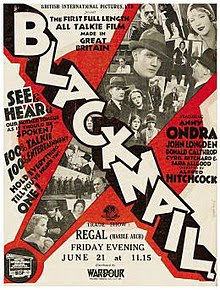
Alfred Hitchcock's first film with sound.  Of all the movies discussed in this and the previous entry, I found Blackmail the most interesting.  Curious about movie history?  Sunrise and Metropolis are must-see films.  Looking to watch a great performance?  Mary Pickford in Coquette and Emil Jannings in The Last Command stand out.  But however good these other movies are, Blackmail is far more absorbing.  The performances, the staging, the way in which it was filmed all point toward an attention to detail that would loom large over subsequent decades of movie history, anticipating not only the director's own Psycho and Frenzy but also the British film industry as a whole.

Parting Thoughts
 
Hopefully I'm done with silent films with this entry.  Honestly, my patience with them is wearing thin.  Sitting through movies such as 7th Heaven and White Shadows in the South Seas has been instructive, but I'll be glad to see the silent era draw to a close with this entry.  I admire both the art and the artifice at work in those films, but I also enjoy the sound of people talking.

Related Entries: